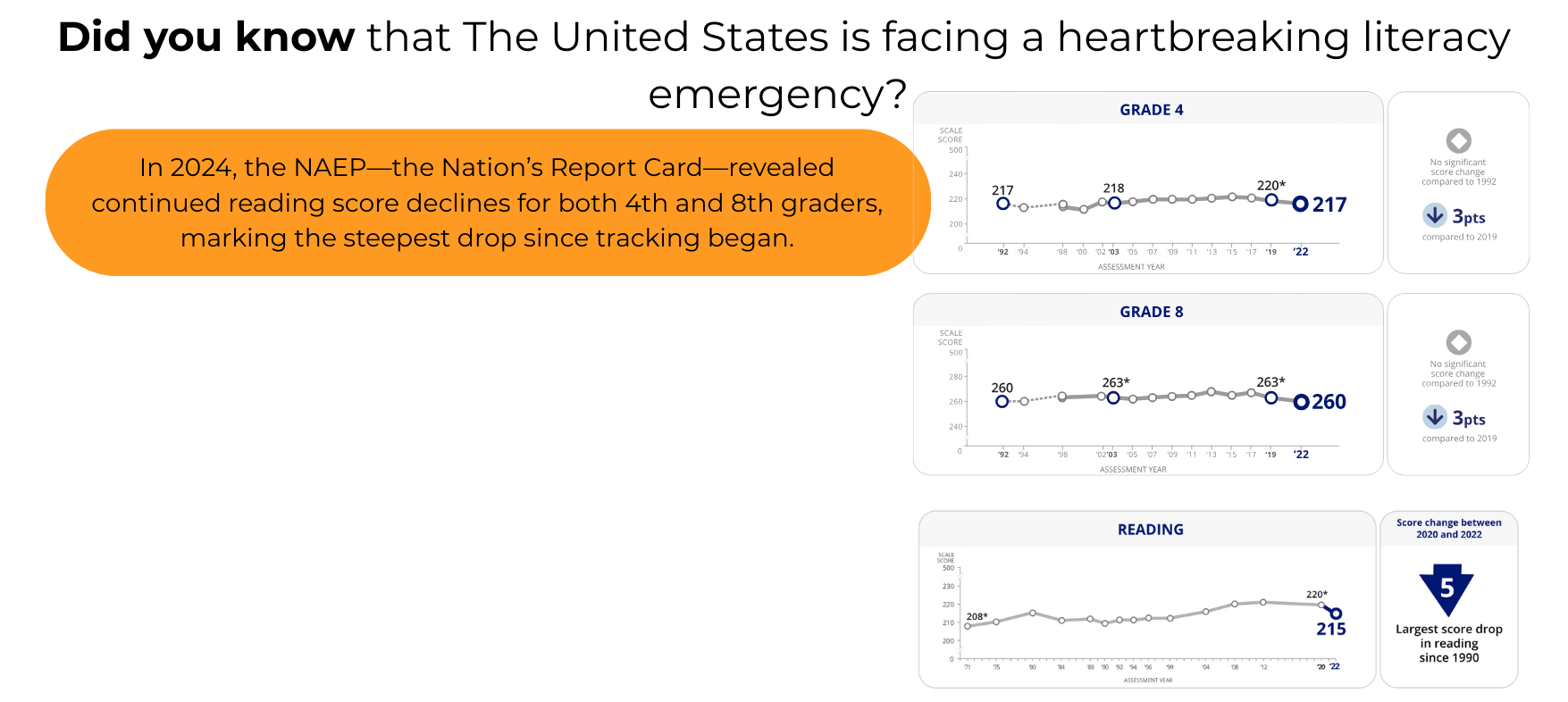

This decline didn't emerge in a vacuum. The COVID-19 pandemic disrupted learning across the country, and the numbers are staggering:A special assessment found 9-year-olds’ reading scores dropped 5 points, and math scores dropped 7 points compared to 2020—the worst declines in decades.Nation's Report CardA national study covering 5 million students in grades 3–8 found reading scores in Fall 2021 were 0.09 to 0.17 standard deviations lower than Fall 2019, especially among grades 3–5 students.National Center for Education Statistics+6PMC+6WTOP News+6On average, students nationwide are now half a grade level behind in reading and math, with pandemic-era trauma and disrupted instruction taking a toll—especially in high-poverty areas.AP News+1



…that when students engage in the performing arts, from music and theatre to storytelling and dance, they consistently see improved literacy and math outcomes, along with boosted writing skills, creativity, and emotional resilience?


The Arts Education Partnership reports that students involved in music score higher on reading and math standardized tests, and that arts experiences deepen understanding and memory of academic content stateimpact.npr.org+7governormifflinsd.org+7steinerschool.org+7.
A comprehensive longitudinal study found that arts participation in kindergarten through 5th grade is positively linked to reading, math, and science scores—even after controlling for family and demographic factors National Endowment for the Arts.
In Baltimore’s Summer Arts & Learning Academy (SALA), over 2,000 pre-K–5 students showed significant gains in reading comprehension, writing, math, and social-emotional skills after intensive arts integration programming youngaudiences.org+1.
A Houston-wide randomized study found that schools with enriched arts experiences showed higher standardized writing scores, better student behavior, increased school engagement, and stronger college aspirations Wallace Foundation.
Despite compelling evidence, arts programs are still the first to be cut when school budgets tighten:
One analysis noted that many school districts make the difficult choice to eliminate art programs; like drama, music, and visual arts, when budgets shrink, especially in low-income schools pmc.ncbi.nlm.nih.gov+15teachnkidslearn.com+15stateimpact.npr.org+15.
In Oklahoma, districts eliminated over 1,100 fine arts classes between 2014 and 2018. By 2018, almost 30% of students attended schools offering no fine arts at all stateimpact.npr.org.
A study of funding decisions confirmed that arts education is among the first to be cut, even though they’re widely recognized as essential to a well-rounded curriculum artsednj.org.